What the Ultra-Wealthy Struggle With — And What You Can Learn
There’s a part of my coaching work I’ve rarely spoken about.
With discretion in mind, I’ve kept it quiet.
But after years of spending time with people on the far side of extreme privilege, I think some of what I’ve seen is worth respectfully sharing.
Because these lessons don’t just apply to the ultra-wealthy.
They apply to anyone searching for meaning.
The Illusion of “Having It All”
Some of my clients own yachts, homes scattered across continents, and a jet.
From the outside, it looks like they have everything.
But if there’s one truth I’ve seen over and over again, it’s this:
Wealth doesn’t insulate you from struggle.
The people in this particular club wrestle with the same things the rest of us do: loneliness, a thin sense of purpose, the quiet weight of everyone’s expectations.
Imagine inheriting massive fortunes but none of the passion that built them.
Or of being several generations removed from the origin story — raised in dynasties, royalty, or legacies you feel disconnected from, yet are expected to carry forward.
It’s not about missing money.
It’s about missing meaning.
And meaning is hard to find when comfort is unlimited and distractions arrive faster than self-reflection.
In that silence between accomplishments, when the applause fades and the next purchase doesn’t move the needle, you’re left with the same question we all face — one that no amount of wealth can answer for you:
What is all of this for?
Why Purpose Feels So Hard
When you don’t need to work to survive, the question becomes: Where do I direct my time to avoid being stuck in my head, locked into old stories, and wedged in an expectations trap?
I suggest volunteering or giving back, and the reaction is often deeply conflicted. They worry that stepping into service means stepping into another performance:
“If I get involved, I’ll be expected to launch a foundation, host events, hire a team. I’ll be compared to others. It becomes a business.”
And just like that, the instinct to serve gets smothered by the pressure to scale, to be visible, to shine.
But purpose doesn’t need a brand or a boardroom.
Sometimes, it just needs a small act — done quietly, sincerely, and without anyone else needing to know it happened.
In fact, the smallest acts of purpose often have the longest reach — not because they’re broadcast to the world, but because they quietly reshape the person doing them.
Start Small. Stay Real.
I always offer the same advice:
Start small. Stay human. Ignore the optics.
Read to underprivileged kids.
Fund a permaculture garden.
Walk dogs at a shelter.
Donate anonymously to a handful of small organizations.
Volunteer without fanfare.
These micro-actions carry extraordinary weight — because they reconnect you to a version of yourself that isn’t built on status.
I speak from experience.
Years ago, I raised a few hundred dollars to support a permaculture project in Africa. I didn’t know anything about gardening and very little about Sub-Saharan Africa. I just wanted to help. That one act opened a decade of relationships, low-pressure fundraising, & visiting villages in Malawi that brought immense meaning to my life — without ever turning it into a “project.”
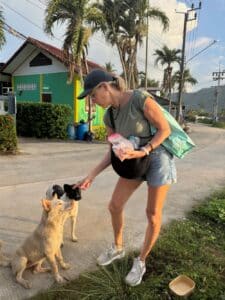
More recently, my wife and I moved to Thailand and saw firsthand the overwhelming problem of street dogs. We’re not vets or NGO founders — just people who care. So we started feeding a few. Getting them sterilized. Responding to emergencies. Handling one at a time. Eighteen months on, we’ve got a roster of sixty dogs in the area, and we deliver food, medicine, and vet care to all of them.
It’s not a global initiative and it’s a fraction of what others in this space do. It’s just what we can do.
And it’s enough. Enough to give us a spark.
Enough to connect us — to the dogs, the neighborhood, each other. I’m honestly more proud of the little notebook I made to track all of them than I’ve been over websites and apps I’ve built over the years.
When Resistance Speaks Loudest
With clients shaped by legacy, the resistance tends to arrive in a familiar set of lines. This isn’t how my family does things. If I can’t do it at a world-class level, why bother. I’ll look like I’m wasting my potential. Those aren’t really doubts. They’re inherited stories. A good part of my job is helping people take back authorship of their own narrative, not by torching the past but by getting to choose the next paragraph themselves.
Because transformation almost never starts with reinvention. It starts with reconnection.
So here’s the part that holds whether you’ve got thirty million in the bank or three hundred, or you’re simply between chapters and not sure what the next one looks like:
You’re the author of your story.
Not your parents.
Not your past.
Not your net worth.
You.
And you don’t have to write the whole novel this week. Not even the next chapter. Just the next paragraph. Just enough to pull one thread toward something real.
Free — The Green Supercharger
Real Coaching, Not a PDF Teaser
A course video, a coaching audio, a guided visualization, and a 5-page reference guide — four formats of the same tool I’ve coached for twenty years. One color. Everything you need to use it. Free.